

What Is SEO (And How Does AI Fit In)? Why It’s Still Key to Your Success
Does your website have a comprehensive SEO strategy? If not, it’s time to develop one and that’s still true now that everyone’s talking about AI. Without proper optimisation, Google won’t index your site. The AI tools your potential clients increasingly use to search won’t find it either. And without that visibility, your site won’t get the traffic it needs.
Google, and increasingly AI search engines and chatbots, need to understand what your site’s about before they’ll send the right people your way. That’s what optimisation does.
No matter what your business goals are, you need website traffic to get there. That hasn’t changed. What has changed is how people are finding you — and that’s exactly what I want to unpack in this post.
What Is SEO And How Does It Work?
SEO stands for search engine optimisation. It’s the set of practices and tactics that improve a web page’s rank in organic search results. In plain language, it helps Google find your website and helps the right people find you through Google. If you don’t use SEO, Google won’t find your site and send the right people to it.
SEO involves using keywords with high search volume strategically throughout a site’s content and metadata. These are the terms people type in when searching for your product, service, or site. The terms also tell Google what your website is about. That’s why it appears in search results when people type those keywords. Successful SEO relies on keywords and your site’s linking structure. That includes both on-page internal links and external links from other sites and social media.
Sounds complicated? It’s really not, once you get the hang of it. There are SEO specialists who provide services to small businesses and work on the backend of their websites. However, you can absolutely handle your own SEO by learning a few strategies and tricks. It’s much less complicated than most people realise.
And Now There’s AI in the Mix
Here’s what’s new since I last wrote about this topic. Google is no longer the only place people go to find you.
More and more of your potential clients are asking ChatGPT, Perplexity, Gemini or Claude for recommendations, instead of typing a search into Google. They’re asking things like “who’s a good business coach for therapists” or “how do I market a yoga studio without feeling salesy.” Google itself has also changed the game with AI Overviews. These are AI-generated summary boxes that now appear above the traditional list of blue links for a huge number of searches.
What this means in practice is that a lot of searches never turn into a click at all. The person gets their answer straight from the AI summary and moves on. It sounds a little alarming, and I won’t pretend it isn’t a shift worth paying attention to. But it also opens up a new opportunity: becoming the source that AI quotes.
When an AI Overview cites your content, or ChatGPT names you as a recommendation, that’s a powerful form of visibility and trust. It often carries more weight than a standard search listing, because it arrives with a built-in stamp of credibility.
The reassuring news? AI search engines want much the same things Google has trained us to provide for the last decade. That means clear, genuinely useful, well-organised content from a credible source. Good SEO and AI visibility aren’t competing goals; they’re two sides of the same coin. Let’s look at why, and how you can make them work together, rather than treating AI as one more thing to panic about.
Why Your Business Needs an SEO Strategy
There are several reasons why an SEO strategy is essential, whether you’re a large company or a small business trying to expand its online presence.
Organic Traffic Is Free
Small businesses adopt SEO for one main reason: because they want organic search, not paid advertising, to become their primary traffic source. Companies that pay for clicks have a large advertising budget. Small businesses need to get creative instead. SEO, including showing up well in AI answers, is one of the most cost-effective ways to do that.
Most People Stay on the First Page
With organic traffic, people visit Google and type in questions or queries related to your product, service, or business. SEO helps your site appear on the first page of Google’s results for your chosen keywords. Increasingly, that means appearing alongside the paid ads, or even inside the AI Overview.
This greatly increases the chances that people searching for those terms will see your page. Most people don’t look beyond the first page of results. So it’s a huge benefit if you can get there or better still, get quoted directly.
More Visibility Means More Sales
Increased visibility through organic search and AI mentions means higher conversions. This could mean more sales, downloads of your free resource, newsletter subscriptions, sign-ups, whatever business goal you want SEO to help you achieve. Interestingly, early data suggests people who arrive via an AI recommendation often have higher intent. The AI has already done some of the persuading for you.
Higher Ranking (and AI Visibility) Implies Expertise
In addition to traffic, SEO is important for building trust and credibility. If your site appears in Google’s results, or an AI tool names you as a source, this tells people you’re a legitimate business worth visiting. More people will see you online. This helps frame you as an expert in your niche and a reliable source for the products and services you offer.
SEO Research Provides Customer Insights
Another benefit is that SEO helps you better understand your customer. Through keyword research, you’ll discover what problems your customers face and what questions they’re asking. That now includes the fuller, more conversational questions people type into AI chatbots. Your website analytics will yield valuable insights that you can use to further refine your marketing strategy.
In the end, SEO helps you grow traffic and authority, so you get more results for the effort you put into online marketing. That’s true whether the traffic arrives via a search click or an AI recommendation.
SEO Best Practices: Yesterday, Today, and in the Age of AI
SEO has changed a great deal over the years. Right now, it’s arguably changing faster than at any point since Google first launched. It used to focus heavily on keyword density and the quantity of backlinks. You could stuff your pages full of high-search-volume keywords and the search engines would index your site and send traffic.
Then Google became dominant, mostly thanks to its smart algorithms, by directing traffic to sites that offer valuable content and a good user experience. Quality over quantity. That single shift underpins everything that’s happened since, including the arrival of AI search. It’s simply the next, more sophisticated version of the same principle: reward the source that genuinely helps the person asking.
Here’s what Google, and now AI tools, look for when evaluating (and citing) websites:
Fresh Content
Google, and AI models pulling in real-time information, both favour sites you update regularly. This is why it’s a good idea to add a blog to your static company webpage. A blog gives you the chance to add content on a regular basis, which tells Google (and AI crawlers) that you’re active and current. Content that’s gone stale is far more likely to lose its place. That might mean dropping down the rankings, or dropping out of an AI’s answer altogether.
Real Value
Real value means your site solves problems, answers questions, and provides value for your visitors. People come there looking for information, and your site delivers on its promises. It doesn’t rely on low-quality filler, and it’s not purely promotional. AI tools are particularly good at spotting (and skipping over) thin, padded-out content, so this matters more than ever.
Good User Experience
A good user experience simply means your site is fun and easy to use. It’s visually appealing, with plenty of images, and easy to understand and navigate. It also clearly shows your visitors how to find what they’re looking for. It should also work beautifully across every device your visitors use to access it.
Topic Relevance
Your website’s content is relevant to the keywords it targets and the products and services it offers.
Quality Backlinks and Mentions
The backlinks into your site should be from authority websites in your niche or relevant to your topic. The quality of these links matters more than the number. AI tools work in a similar way. They draw on what reputable third-party sites, reviews, and directories say about you, not just what’s on your own homepage. So look for chances to get mentioned well elsewhere online: a guest podcast, a feature in an industry roundup, a glowing client testimonial on someone else’s site. All of that genuinely feeds your visibility with both Google and AI.
Clear, Scannable Structure
This one’s increasingly important for AI visibility specifically. When you organise content into headings, short answers, bullet points, tables and FAQs, it’s simply easier for an AI to lift and quote accurately. Answer the core question plainly near the top of your page, then expand with detail underneath. That gives both human readers and AI tools exactly what they need.
A Named, Credible Author
Readers and AI systems alike tend to trust content more when it carries a real person’s name, along with a bit of background on their expertise. As a coach or practitioner, this one plays to your strengths. Your personal story and credentials are a genuine asset, so don’t be shy about including a proper author bio.
This means that your site should:
-
- Target keywords (and increasingly, full questions) relevant to your topic
- Use keywords naturally throughout the text and in key places that Google considers important
- Add secondary keywords wherever appropriate for further traffic
- Include these terms in URLs, descriptions, images, and metadata
- Answer key questions clearly and early, using headings, lists, and FAQs where they help
- Have an internal linking structure that helps Google (and AI crawlers) understand your site’s architecture
- Employ some off-page SEO, like backlinks and mentions from authority sites
- Attribute content to a real person with genuine expertise
- Be updated frequently with new and refreshed content.
How AI and SEO Actually Work Together
I know AI can feel like just one more overwhelming thing to keep on top of. So let’s make this simple: AI isn’t replacing SEO, and it isn’t something separate you now also have to do. Think of it as a two-way relationship.
AI rewards good SEO. Everything that’s always made for strong SEO – clarity, genuine expertise, good structure, credibility, freshness – earns you visibility with AI, too. It’s what gets you a mention in an AI Overview, or a recommendation from ChatGPT. If you’ve been doing SEO properly, you’re already most of the way there.
AI can help you do SEO, too. Used well, AI tools are a brilliant support for the SEO work itself. You can use them to brainstorm long-tail keyword ideas, draft a blog post outline, or generate FAQ questions your clients are likely to ask. They’re also handy for summarising your analytics or repurposing a blog post into social captions and email content. It won’t think for you, and please don’t let it write in a voice that doesn’t sound like you. But it’s a genuinely calm way to get past a blank page.
Used together, this is a lovely little loop. You research and write with real expertise, structure it well for both humans and AI, and use AI tools to make the process faster and less overwhelming along the way.
How to Get Started
Are you ready to get started learning SEO and creating and implementing your own effective SEO strategy? Here’s a simple starting point.
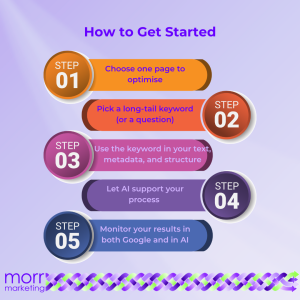
Step 1: Choose One Page to Optimise
The best option is to pick a blog post you want the world to see. Choose a post that’s your best “start here” content, or write something original on a very popular topic in your niche.
Step 2: Pick a Long-Tail Keyword (or a Question)
A long-tail keyword is a term that’s 3–5 words in length, or it could be an entire sentence or question. These are preferable because there’s less competition for them in searches. They’re also specific, so you get more targeted traffic. This matters even more now. Think about the fuller, more natural questions your ideal client might type into ChatGPT, not just what they’d search on Google.
Step 3: Use the Keyword in Your Text, Metadata, and Structure
You should also optimise your site using a plugin like Yoast or RankMath. It’ll walk you through a variety of techniques to make your site easier for Google to index. Alongside this, structure your content so it’s easy to scan. Put a clear answer near the top, followed by headings, bullet points, and an FAQ section where it fits naturally. This is what gives you the best shot with AI tools, too.
Step 4: Let AI Support Your Process (Without Taking Over Your Voice)
Use an AI tool to help with keyword brainstorming, outlining, or drafting FAQ questions. Then write or edit the final piece yourself, so it genuinely sounds like you. Your warmth, your experience, and your particular way of explaining things are what your clients connect with. Handily, that’s also what makes your content harder for anyone else to replicate.
Step 5: Monitor Your Results in both Google and in AI
Check your ranking for your chosen keyword and review your website’s analytics, as before. Then add one new habit. Every so often, ask ChatGPT or Perplexity a question a potential client might ask in your niche, and see whether you come up. It’s an informal check, but it’ll give you a real feel for your AI visibility. Through this trial-and-error process, you’ll become an expert in your own right.
That covers both SEO and this new AI layer sitting on top of it.
SEO was never about chasing a search engine’s rules for their own sake. It’s about being genuinely useful and easy to find for the people who need what you offer. That’s true whether it’s whoever or whatever is doing the finding on their behalf. Which part of this feels like the biggest opportunity for your business right now: showing up better on Google, or getting on AI’s radar?